FIRST-BATCH READINESS
Compare a complete start, not the accessory count
Mark each row included, already owned, still needed, or unknown. An unknown is a research task, not a reason to assume the kit is complete.
| Requirement | Evidence that closes the gap | If it is missing or unknown | Your status |
|---|---|---|---|
| Machine, barrel, and exact-model manual | The model identity matches the manual, and the loading limit is defined. | Pause the purchase until the seller or manufacturer resolves the model and load definition. | □ Included □ Owned □ Needed □ Unknown |
| Compatible rough for one coherent load | The stone identity, condition, and batch compatibility are clear enough to follow one process. | Choose identified beginner rough or research the stones before committing them to a batch. | □ Included □ Owned □ Needed □ Unknown |
| Named abrasives for every planned stage | Each packet has a material or grade and can be matched to the chosen instructions. | Price the absent stages as part of the ready-to-start cost; do not treat unlabeled powder as interchangeable. | □ Included □ Owned □ Needed □ Unknown |
| Final polish and recipe-required media | The final material and any required cushioning or filler are identified for the intended process. | Confirm the exact recipe before buying a generic refill or assuming media is optional. | □ Included □ Owned □ Needed □ Unknown |
| Measuring, labeling, and cleanup plan | Dedicated tools, stage labels, storage, and a slurry-disposal plan are ready before opening packets. | Add these household workflow items to the checklist even when they are not sold with the machine. | □ Included □ Owned □ Needed □ Unknown |
| Operating place, inspections, and support | The location, check routine, contact path, and likely wear parts are acceptable for the household. | Choose a different location or model when safe access, supervision, documentation, or parts remain unresolved. | □ Included □ Owned □ Needed □ Unknown |
Printing uses your browser’s print dialog. Nothing entered or marked on a paper copy is stored by this site.
FOUR PRESERVED CANDIDATES
Choose by fit and evidence—not a winner badge
These candidates use existing approved catalog records. The table separates exact-model evidence from related-family or catalog-title claims. We did not hands-on test or rank these machines.
| Candidate | Useful when | Evidence status | Resolve before ordering |
|---|---|---|---|
| KomeStone K1ASIN B09PYR2RRT | A single-batch hobbyist who wants adjustable time and speed without managing a second barrel. | Exact K1 manufacturer page plus current K1/K1 Pro support pathOpen model evidence | A shared support path does not establish identical parts or specifications. Match the supplied manual and wear parts to K1, not merely a nearby K-series name. |
| KoolStone C1ASIN B09YM33DGD | A buyer comparing a catalog-listed programmable single-barrel model who will read the current C1 manual before relying on its controls. | Current C1 manual entry plus catalog identity; former model page is unavailableOpen model evidence | The former C1 product page returned 404 on September 8, 2026. Treat numerical controls as listing claims until the current C1 manual and machine label agree; do not transfer Pro or Ultra claims. |
| National Geographic HobbyASIN B01LQCIL88 | A household that wants a guided first look at the full rotary sequence and can verify the exact box contents. | Current Hobby family page and support path; saved listing revision unresolvedOpen model evidence | The saved listing revision is unresolved. Do not transfer current rough, grit, GemFoam, barrel, or noise claims to this ASIN. |
| KomeStone K4ASIN B0GHY7RRTZ | A buyer researching a catalog-listed two-barrel format who can resolve the exact model, load limits, and manual before operating it. | Saved catalog identity plus current K4-specific replacement-belt page; exact model page and manual unresolvedOpen model evidence | The linked primary source supports belt identity only. Capacity, motor, cover, per-barrel load definitions, and independently adjustable controls remain unresolved for this ASIN. |
Compare the four preserved starter-kit listings
The approved images, ASINs, and tracked destinations are unchanged. Confirm the exact package contents, current seller details, and model manual before ordering.
As an Amazon Associate, we earn from qualifying purchases.

KomeStone K1 Quiet Rock Tumbler Kit for Adults, Kids & Families
Starter kit · Rotary tumbler · ASIN B09PYR2RRT
Why compare this listing: A single-batch hobbyist who wants adjustable time and speed without managing a second barrel.
Hold until resolved: A shared support path does not establish identical parts or specifications. Match the supplied manual and wear parts to K1, not merely a nearby K-series name.
Evidence status: Exact K1 manufacturer page plus current K1/K1 Pro support path
What is documented: KomeStone provides a K1 model page and a current Help Center path labeled for K1/K1 Pro support.
Open model evidence
KoolStone C1 Rock Tumbler Kit - 2.5LB Rotary Rock Tumbler for Adults & Beginner Hobbyists, Quiet Rubber Barrel, Adjustable Timer & 3 Speeds, Complete Gem Polishing Kit with Memory Function
Starter kit · Rotary tumbler · ASIN B09YM33DGD
Why compare this listing: A buyer comparing a catalog-listed programmable single-barrel model who will read the current C1 manual before relying on its controls.
Hold until resolved: The former C1 product page returned 404 on September 8, 2026. Treat numerical controls as listing claims until the current C1 manual and machine label agree; do not transfer Pro or Ultra claims.
Evidence status: Current C1 manual entry plus catalog identity; former model page is unavailable
What is documented: KoolStone's current manual index lists C1 separately from C1 Pro, C1 Pro Max, and C1 Pro Ultra.
Open model evidence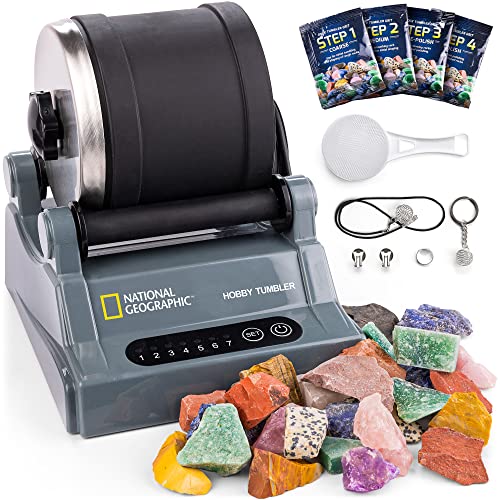
National Geographic Hobby Rock Tumbler Kit for Kids and Adults Ages 8+
Starter kit · Rotary tumbler · ASIN B01LQCIL88
Related listing group: National Geographic machine and kit listings
The saved titles distinguish Hobby, Starter, Professional, bundle, 2 lb, and 3 lb wording. Those labels do not prove revision, package, control, noise, or performance parity. Match the exact box and supplied manual.
Why compare this listing: A household that wants a guided first look at the full rotary sequence and can verify the exact box contents.
Hold until resolved: The saved listing revision is unresolved. Do not transfer current rough, grit, GemFoam, barrel, or noise claims to this ASIN.
Evidence status: Current Hobby family page and support path; saved listing revision unresolved
What is documented: Blue Marble's current comparison guide separates Hobby from Starter, Professional, and Platinum families.
Open model evidence
KomeStone K4 Quiet Rock Tumbler Kit for Adults, 7LB Large Double-Barrel
Saved-title double barrel · Starter kit · Rotary tumbler · ASIN B0GHY7RRTZ
Why compare this listing: A buyer researching a catalog-listed two-barrel format who can resolve the exact model, load limits, and manual before operating it.
Hold until resolved: The linked primary source supports belt identity only. Capacity, motor, cover, per-barrel load definitions, and independently adjustable controls remain unresolved for this ASIN.
Evidence status: Saved catalog identity plus current K4-specific replacement-belt page; exact model page and manual unresolved
What is documented: KomeStone's current Help Center gives K4 its own support path, and its K4 belt page states that those belts do not fit other models.
Open model evidenceStart with a first-batch brief
Write down what you want to tumble, how much suitable material you already have, who will handle the changes between stages, and where the machine will stay. If you cannot answer the material question, a clearly identified beginner rough mix is easier to evaluate than a bag described only as assorted gemstones. You are trying to reduce the number of unknowns in the first experiment.
Our buying approach gives more weight to a readable manual and a manageable load than to controls you may never use. A basic machine with clear support can be a better fit than a feature-rich machine whose barrel limits and refill instructions are unclear.
Compare the details that affect everyday use
The Lortone 3A manufacturer page illustrates the information worth looking for: barrel construction, intended stone size, dimensions, and maintenance instructions. That is a useful documentation example, not a claim that we have tested or ranked that machine against every starter kit.
- Barrel and load: find the exact loading instructions and understand what the capacity figure measures.
- Space: compare the machine footprint plus clearance for ventilation, the cord, and removing the barrel.
- Service: locate the manual, supplier contact, and compatible wear parts before buying.
- Controls: ask what a timer or speed control changes for the intended material, rather than treating more settings as automatically better.
- Refills: identify the abrasive and final polish, their quantities, and the instructions for the exact machine.
Treat a starter kit as a bill of materials
Use four statuses: included, already owned, still needed, and unknown. Enter the tumbler, exact manual, suitable rough, named abrasives, final polish, any recipe-required media, measuring and labeling tools, and a cleanup arrangement. A kit that includes jewelry findings may be enjoyable, but those findings do not replace missing consumables. Conversely, you do not need every optional accessory before the first batch.
Keep the comparison fair by bringing both offers to the same starting point. Compare the cost of getting each option ready for the same first batch. Do not compare a bare machine against an all-in-one bundle without accounting for what is missing.
Choose your compromise before choosing your brand
A smaller batch can be appropriate when collecting enough compatible stones is the main constraint. Two barrels can help two people keep projects separate. Neither choice removes the need for cleaning and record keeping. Decide which inconvenience you most want to avoid: waiting for enough rough, managing multiple containers, or finding more space.
Before ordering, save the model name, manual link, included consumables, and your unanswered questions. If a seller cannot clarify an essential detail, keep that model on a research list rather than filling the gap with assumptions. Your first purchase should leave enough budget for the second batch, when you will know far more about your own preferences.
Questions at the workbench
Is the most expensive beginner rock tumbler the best choice?
Not automatically. Choose a documented machine that fits your available space, realistic batch size, and refill budget. Additional capacity or controls have value only if you will use them.
Should I buy a kit or a tumbler alone?
A kit is convenient when its rough and consumables are clearly identified and suitable for the machine. A bare tumbler can make sense if you already own suitable supplies and can compare the complete starting cost.
Can a beginner use a hobbyist machine?
Yes, if its manual, loading requirements, operating location, and maintenance are manageable. Beginner suitability is a practical fit question, not simply a label on the box.
Sources & further reading
- Lortone: 3A Rotary Tumbler
- RockTumbler.com: Beginner’s Mix tumbling rough
- KomeStone: K1 exact-model page
- KoolStone: current model manual index
- Blue Marble: choosing a National Geographic tumbler configuration
Machine instructions take precedence for its loading, materials, operation, and maintenance. Send a correction.